

FOR IMMEDIATE RELEASE
April 1, 2025
Press Contact:
Jama Joseph
jama.joseph@weact.org
(646) 951-1648
You can view a recording of today’s press conference here.
Fund would upgrade and enable energy savings for 10,000 homes
Albany, NY – A new report from the Fiscal Policy Institute, released today at the New York State Capitol, reveals that between 550,000 and 1.1 million low- and moderate-income (LMI) households in New York State face significant barriers to accessing energy efficiency and electrification programs due to unresolved health and safety issues in their homes. The report, for which WE ACT 4 Change provided financial support, finds that a $200 million annual investment in the Green Affordable Pre-Electrification (GAP) Fund (S.3315/A.2101) could help remediate at least 10,000 homes per year, enabling them to qualify for critical energy efficiency upgrades.
The report highlights that nearly 70% of LMI households in New York State reside in older housing stock, which often contains hazardous conditions such as lead, mold, asbestos, and other structural code violations. These health and safety issues make it nearly impossible for these households to access existing energy efficiency programs that could lower their energy costs and improve living conditions. Because state programs do not cover pre-electrification remediation costs, thousands of households remain locked out of New York’s clean energy transition.
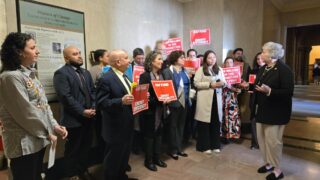
At a press conference held today outside the Legislative Correspondents Association (LCA) press offices, state legislators and advocates joined forces to call for $200 million for the GAP Fund in the final budget.
Senators Kristen Gonzalez, Cordell Cleare, and Anna Kelles, Assembly Energy Committee Chair Didi Barrett, and Assembly Members Linda B. Rosenthal and Pete Harckham joined representatives from Alliance for a Green Economy, WE ACT 4 Change, NY Renews, New Yorkers for Clean Power, Energy Democracy Alliance, and NYPIRG in emphasizing the importance of this critical investment.
Kristen Gonzalez, Senate sponsor of the GAP Fund, said, “To meet our CLCPA goals, to become a greener New York, and to help working-class New Yorkers afford the transition to clean energy– we need the GAP Fund. If passed in the State Budget, the GAP Fund would provide 10,000 middle-to-low income households $200 million to retrofit their homes to be safe, sustainable, and affordable. In the midst of an affordability crisis and the climate crisis, the urgency is clear, and I urge the leaders of our state to include this fund in the final budget.”
“We know that the oldest buildings needing the most repair are also the most energy inefficient. This analysis shows that by funding pre-electrification upgrades and making energy efficiency programs easily accessible to low and moderate income folks, we can have a huge impact both reducing costs and improving well being for a large number of people,” said New York State Assemblymember Anna Kelles.
Didi Barrett, Assembly Energy Committee Chair, said, “Our job in the legislature is to ensure our communities are able to access the funding programs we put in place. Health hazards like mold and asbestos in homes currently pose a barrier for low and moderate income New Yorkers to access critical energy efficiency and electrification funding. I stand with my colleagues in support of closing this gap with the GAP Fund to provide funding to remediate these health hazards, opening up affordable pathways to energy efficiency.”
Pete Harkham, State Senator, said, “I support the Green Affordable Pre-Electrification Program (GAP Fund) because many low- and moderate-income New Yorkers hoping to upgrade and retrofit their homes before electrification and energy-efficient projects can take place need financial help to do so. These incentives will result in lower energy costs, plus cleaner air for our communities and better health outcomes for our residents as we transition away from fossil fuel use.”
Linda B. Rosenthal, Assemblymember and Chair of the Assembly Committee on Housing, said: “Safe and affordable homes should be available to all New Yorkers, but our aging housing stock has left many people living in homes with lead, mold, asbestos and other code violations. The presence of these health hazards has excluded many households from participating in existing weatherization and energy efficiency programs, underscoring the need for a fully funded Green Affordable Pre-Electrification Fund. As we work toward a clean energy future, we cannot leave families behind in drafty, toxic and unhealthy homes. For the health of all New Yorkers and our climate, our final enacted budget must make a strong investment in the GAP Fund.”
Julia Salazar, State Senator, said: “New Yorkers are facing an affordability crisis on top of the climate crisis, but the Green Affordable Pre-Electrification Fund would help address both simultaneously. By covering weatherization and electrification upgrades for 10,000 homes, the Fund would reduce New Yorkers’ energy costs and carbon emissions. Both the Senate and Assembly recognized the urgency of this commonsense measure by including it in the one-house budgets. Now we must ensure the Green Affordable Pre-Electrification Fund is our final budget.”
Sarahana Shrestha, Assemblymember, said, “Low-to-moderate income households are currently unable to benefit from various electrification and energy upgrade programs because of barriers to pre-requisites like weatherizing. Many such homes exist in my district in the Hudson Valley, where around 59% of the housing stock was built before 1970. We need to invest $200 million this year to close that gap, and ensure the state’s commitment to a future of healthy homes leaves no one behind.”
Lea Webb, State Senator, said, “Investing in the Green Affordable Pre-Electrification (GAP) Fund is an investment in our families, our communities, and our future. Too many homes in our state are in disrepair, making them ineligible for energy efficiency upgrades that would lower costs and improve quality of life. This fund will help fix homes—making them healthier, safer, and more livable—while also preparing them for cost-saving weatherization and electrification upgrades.”
Jo Anne Simon, Assemblymember, said, “Our clean energy future must be accessible to everyone—not just those living in newer homes. Many families in older housing face lead, asbestos, and other hazards that block them from accessing cost-saving energy efficiency programs. The GAP Fund will remove these barriers, ensuring safer, healthier, and more sustainable homes across New York.”
Jessica Azulay, Executive Director of Alliance for a Green Economy (AGREE), said, “This $200 million will be the difference between whether ten thousand New York families will be able to make their homes safer, healthier, and more comfortable, and lower bills while doing it… or not. The Assembly, Senate, and Governor Hochul can’t miss this opportunity to deliver such a vital program for New Yorkers.”
Bob Rossi, Executive Director of the New York Sustainable Business Council, said, “The business community was pleased to see the GAP Fund included in the Assembly and Senate one-house budgets. The GAP Fund will strengthen local economies, create meaningful jobs where they are most needed, and address a decades-old issue that has stunted the New York economy. By mitigating the most common home health issues, this program will unlock state and federal funding for much-needed weatherization and pre-electrification.”
Bob Cohen, Policy and Research Director of Citizen Action of York, said, “Buildings are roughly one-third of greenhouse gas emissions statewide, which means that we need to transition our homes, apartments and businesses away from fossil fuels if we are serious about addressing the climate crisis.”
Annie Carforo, Climate Justice Campaigns Manager at WE ACT for Environmental Justice, said, “This report makes it clear: low- and moderate-income households are living in homes that are not prepared for sustainable energy upgrades and face significant health and safety risks. Without the GAP Fund, these families will continue to be locked out of energy efficiency programs that lower costs and improve living conditions. New York must fully fund this program to address these inequities and ensure a just transition to clean energy.”
About WE ACT 4 Change
WE ACT 4 Change is a nonprofit organization dedicated to advancing climate justice and environmental health policies that center the needs of frontline communities. Through advocacy, research, and coalition-building, WE ACT 4 Change works to ensure that all people—regardless of income or race—have access to clean air, safe housing, and affordable energy solutions.